
Burlington, This is You!
ABOUT
On Town Meeting Day (where every Vermont town holds state and local elections), we meet CCTV staff, hustling to gather results from in and around Burlington, Vermont. In the morning, they head out in the cold to the polling locations with cameras and wired microphones, a signature prop, to ask local constituents their thoughts about the election. As staff member Travis Washington says to the cohort of volunteers, “We’re CCTV, so we’re bipartisan. We want people to comment on why they vote, not what they voted for.” Emily Brewer, another staff member, is out with two college interns as the local news approaches and asks to team up for interviews. The news exclaims they are only looking for 15-second sound bites; Emily shrugs and says, “We’re looking for a couple minutes; that’s the difference.”
But what is the role of public access TV today? Community Media scholars such as Antoine Haywood, Ph.D., points out how, abound with stereotypes from popular culture the medium is, such as “Wayne’s World.” Jordan Butterfield, a community media practitioner, states that he first thought of it as the “polka shows.” Continually, the court of public opinion attests that the form has lost its modern touch in the face of social media. However, BURLINGTON, THIS IS YOU! tells the story of a community dedicated to social and economic justice through the lens of Community Media Access and asks the question: what does the future hold? What can an archive of community media teach us about activism? Have we prepared the next generation to carry on the work of open media and inclusive change? Who will take up these struggles?
Burlington, the Progressive City, has a long-standing tradition of participatory democracy as is proven by seeing an intergenerational staff, interns, volunteers, and community members come together to participate in local media making. From 2025 back to the early '90s, we can roll back the clock on the station's programming, tracking the 40-year history, weathering an ever-changing media landscape.
Born from a national movement of media activists in the 1970s, CCTV was founded alongside Burlington’s progressive revolution, launched by the election of mayor Bernie Sanders in 1981. At that time, Lauren-Glenn Davitian was a disciple of the documentary film and public access TV movement. Her desire to liberate the means of media production and distribution aligned with the Sanders administration's efforts to engage citizens in local government and build community. This intersection of shared values (and a lengthy battle with resistant cable company lawyers) led to CCTV’s 1984 premiere show on grainy VHS footage as Lauren-Glenn introduced the concept of public access television to Burlington viewers with an avant-garde attitude that would become a staple of the station’s identity for years to come. Burlington’s constituents were engaged.
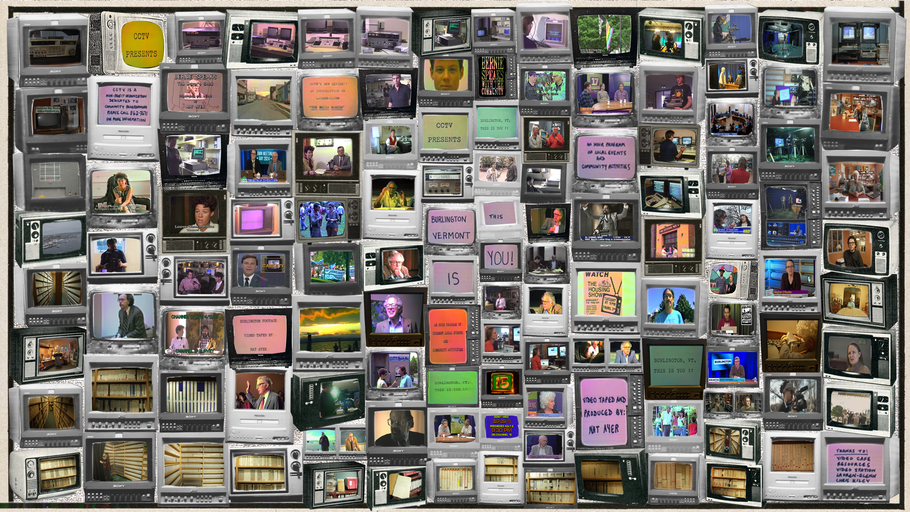
While Lauren-Glenn stood on camera as the outspoken advocate, CCTV co-founder Nat Ayer was typically found behind the camera. Nat was obsessed with documenting Burlington’s vibrant and diverse community life on film. He filmed political demonstrations and press conferences, concerts, quilt festivals, city council meetings, matchbox races, jugglers, and children—clipping it all together for a weekly program called “Burlington, This is YOU!” It was activism in its observational mode.
40 years after its inaugural program, the CCTV Archives now house more than 42,000 programs on tapes and DVDs, filling shelves throughout the studio—a remarkable history of culture and politics in Burlington. The spine of every VHS has Nat’s handwritten notes, a surprise in every event documented. Meghan O’Rourke, CCTV’s Co-Director, brings us into the tape closet and states, “The whole story is right here, not only from municipal meetings but from happenings in the community. You can track the whole story of the city.”
CCTV’s history and future are then seen through the lenses of the countless community activists from multiple political and social persuasions who have used the means of community media production and distribution to tell their stories and galvanize support. Its next generation of leadership takes the helm with a lot on its plate. BURLINGTON, THIS IS YOU! leaves viewers at an important moment in CCTV’s history, one emblematic of a larger turning point in the American media landscape as communities navigate widespread distrust in traditional media models and in democracy itself. But what could a new model even look like? And what lessons can community media centers like CCTV offer as we look toward mending our distrust in civic infrastructure?
MYLES DAVID JEWELL (Co-Director, Co-Producer, Editor) is a Burlington, VT-based freelance filmmaker. He runs Pennington Productions and works independently on both feature documentaries and narrative films. Myles earned a Master of Arts in Cinema Studies from New York University and an Advanced Certificate in Culture and Media. He is a Lecturer at the University of Vermont, focusing on how filmmaking and storytelling can be used to develop community. He believes firmly in the ethics of representation and practices values-based filmmaking with collaborative approaches to media production, working in the community he calls home, Burlington, Vermont.
Lauren-Glenn Davitian (Co-Director, Co-Producer) founded CCTV with Nat Ayer and a cadre of community activists in 1984. She has served as Executive Director and performed a variety of production, administrative, and development functions for the organization since its inception. Lauren-Glenn is the recipient of the George Stoney Award (Alliance for Community Media) and the NTEN Lifetime Achievement Award. She is a graduate of UVM (BA/Anthropology, 1982).
Meghan O’Rourke (Co-Producer) has a solid background in community media making as an independent producer and 20 years with CCTV and Town Meeting TV. She has participated as a collaborative filmmaker with the VT Movie Project and an organizer on the VT Movie Youth Film Contest, helping to build more local community media makers. She is an artist and organizer. She loves to produce but prioritizes making sure others around her have access to the tools, means, and motivation for creating meaningful and engaging media and media experiences.
CREDITS
Lauren-Glenn Davitian
Jordan Mitchell