
The Elversphere
ABOUT
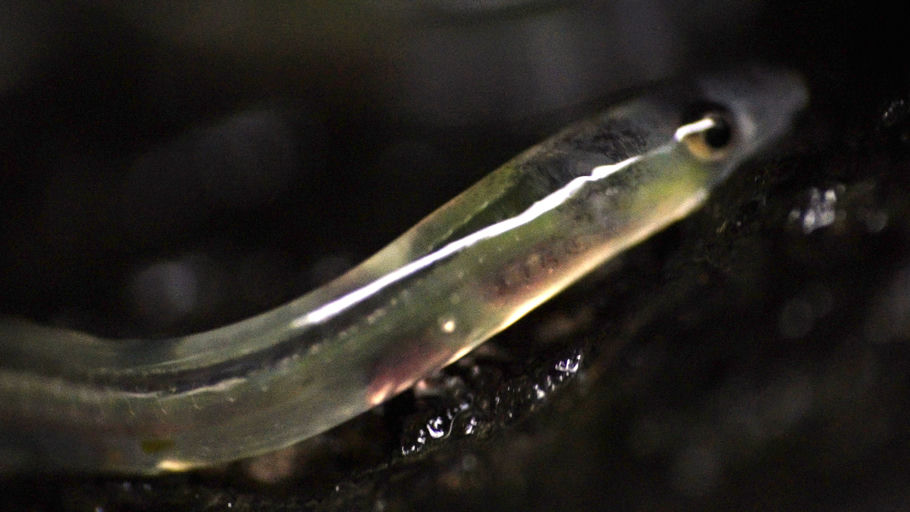
After hatching in the Sargasso Sea, translucent glass eels drift on currents to freshwater systems thousands of miles away. Herein lies the fork in the road. While many eels mature and eventually migrate back to the Sargasso Sea to spawn and die, others are harvested by fishermen who eagerly await their migration. After being sold, these eels are flown to Asia, where they live in aquaculture tanks, multiply in value, and become unagi for the global sushi market. "The Elversphere" follows these two contrasting life cycles and surfaces a multidimensional web of surprising human-eel relations.
A pool full of glass eels who have recently arrived in Maine after journeying from the Sargasso Sea look up at the camera while huddled under a rock, unable to make their way up a dam. A conservationist implores her followers to assist her in scooping them up and back into the river. A buyer purchasing elvers out of a roadside RV sautées a saucepan full of glass eels as a quick meal between transactions.
State fishermen lobby for regulations that support this lucrative fishery and their bad knees. Wabanaki fishermen flex their treaty rights when the elver fishery gets shut down due to violence and poaching, and invoke tribal sovereignty to fight for eel conservation while nervous marine patrol officers look on.
A researcher carries a portable dental X-ray machine to the river’s edge, where he stuns an eel and scans their body for parasites. A state biologist uses a jeweler’s saw to bisect an eel otolith (ear bone), reading both age and a life story in the pattern of rings that are revealed. A fishing guide shares the dying practice of eel weir fishing with the human actors we meet earlier in the film.
Captive elvers are fed a special diet until they become fatty yellow eels, and are served by the thousands at the Japanese festival, Doyo no Ushi no Hi. At a staged funeral for the death of biodiversity, Wabanaki elders advocate for improved relationships with the eel—a relation that has sustained their community and culture since time immemorial. As November rains fall, mature silver eels begin their return journey to the Sargasso Sea for their final act: to spawn new eel larvae before expiring and sinking to the murky depths.
Facing the specter of climate disasters and ecological collapse, amidst a global reckoning with rapacious and extractive capitalism, the need for deep reflection on the premises underlying our current socio-economic systems and relationships with non-human life is critical and urgent. "The Elversphere" aims to open up space for dialogue that supports ecological awareness and collaboration amidst global networks of capital and trade.
Eli Kao is a filmmaker exploring the intersections of culture, knowledge production, and relations to the more-than-human. He has worked in community media, and produced programs for the National Geographic Channel and Discovery Networks in Asia. He directed "Hualien Earthquake Decoded" (Discovery), which won a 2019 Asian Academy Creative Award. Eli attended UnionDocs' 2024 Summer Documentary Lab, and has received grants from the LEF Foundation and the National Endowment for the Arts via SPACE Gallery. His hybrid short, "Heritable," was a 2024 Camden International Film Festival Dirigo Docs selection. Eli works as Documentation Coordinator for the Walk for Historical and Ecological Recovery, and with community media center Torchlight Media. Current documentary projects include an exploration of the network of relations surrounding the freshwater eel, and an inquiry into past and future ideas about multiracial(ized) people.
Michele Christle is a writer and producer whose work focuses on culture, ecology, and place. After serving in the Peace Corps in Cameroon, Michele earned an MFA in Creative Writing from UMass Amherst. Her writing has appeared in The Kenyon Review, Eater, Insider, Down East, and Cultural Survival Quarterly. Michele has 20 years’ experience working in communications, oral history, teaching, and journalism. In recent years, she’s worked with Maine Sea Grant, Maine Audubon, Out in the Open, and as a producer/facilitator for StoryCorps’ One Small Step program through WERU Community Radio. Currently, Michele works with Torchlight Media and Atlantic Black Box’s Walk for Historical and Ecological Recovery. She serves on the Frankfort Dam Committee and the Maine Community Foundation’s Waldo County Committee. The recipient of a Bodwell Fellowship and residencies at Hewnoaks and Shannaghe, Michele is working on a book about eels, informed both by independent reporting and the making of "The Elversphere."